Understanding what happens in your body when weight loss becomes impossible — despite genuine, sustained effort — requires moving past the conventional narrative of "eat less, move more." The science has moved past it. And for women whose experience has already proven that narrative wrong, reading the actual biology is often a profound relief.
This article covers the complete picture of what's actually driving the specific weight pattern you're experiencing — the mechanisms, the research, and what a targeted biological intervention looks like.
- The documented biological mechanisms behind this specific weight pattern
- Why conventional approaches consistently fail to address root causes
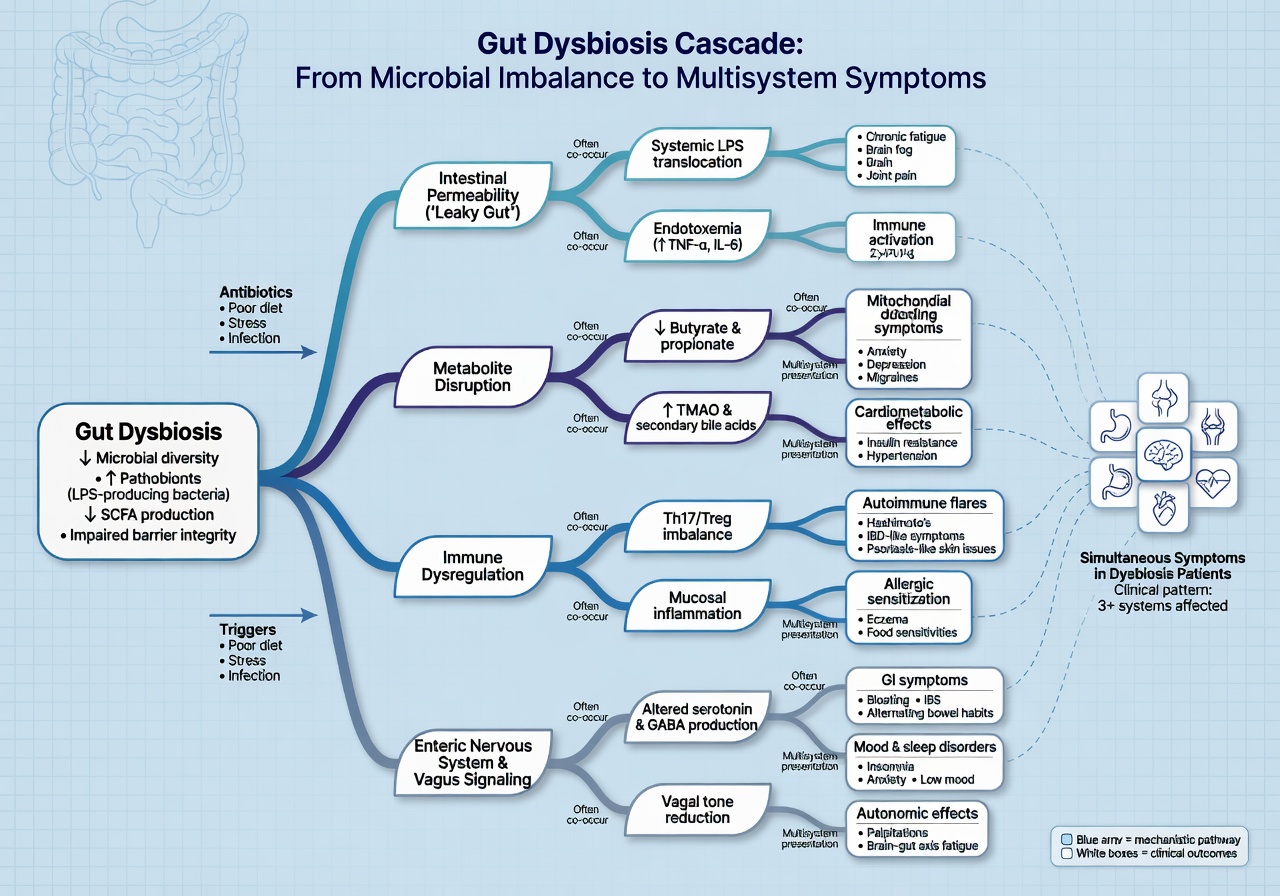
- The gut-metabolic connection linking all these symptoms
- What the clinical evidence shows about effective intervention
- What women who've successfully addressed this report experiencing
The biological foundation
The human body after 40 is not the same metabolic machine it was at 30. This is not motivational rhetoric — it is measurable physiology. The gut microbiome shifts. Hormone production changes. The cellular machinery governing fat oxidation and energy regulation adapts to a new biological reality that most weight loss programs were not designed to address.
The specific mechanisms vary somewhat by angle, but they share a common architecture: gut microbiome disruption sits at the root of virtually every metabolic pattern that becomes more pronounced after 40. When the gut ecosystem changes — as it does measurably and predictably during perimenopause — downstream effects in metabolism, hunger regulation, inflammation, and energy balance follow with biological inevitability.

Studies consistently show that Akkermansia Muciniphila — the gut bacterium most linked to metabolic efficiency — declines significantly during perimenopause, creating a measurable reduction in fat oxidation capacity that persists regardless of dietary behavior.
Why conventional approaches fail
The conventional weight loss toolkit — caloric restriction, increased exercise, dietary changes — addresses the symptom rather than the cause. When the gut microbiome is disrupted, these interventions produce temporary results followed by predictable reversal, because the biological conditions driving the original problem have not changed.
Caloric restriction, specifically, has been shown to worsen gut microbiome diversity in the short term: it reduces dietary fiber (the primary substrate for beneficial gut bacteria), increases cortisol (which directly disrupts the gut environment), and triggers a metabolic suppression response that persists after restriction ends. The tool most commonly used to address the problem actively compounds its root cause.
"The women who achieve lasting metabolic change after 40 are not the ones who try harder. They are the ones who finally address the right problem."
The gut restoration framework
The intervention that research most consistently supports is gut microbiome restoration — specifically targeting the bacterial strains and conditions that govern the specific metabolic dysfunction described here. This means replenishing Akkermansia Muciniphila, activating the cellular energy sensor AMPK through berberine-class compounds, reducing gut-driven inflammation through targeted anti-inflammatory botanicals, and supporting the short-chain fatty acid production that maintains intestinal barrier function.
This is the framework Metaburn™ was designed around. Not as a stimulant or appetite suppressant, but as a comprehensive gut-metabolic restoration formula targeting the biological conditions that make everything else — eating, exercising, sleeping — actually produce the results it should.
What women who've addressed this report
The pattern of response in women who successfully restore gut-metabolic function is remarkably consistent across the clinical literature and patient reports. It tends to follow a specific sequence: digestive improvements first (typically weeks 1–2), followed by hunger normalization (weeks 2–4), then measurable changes in weight and body composition (weeks 4–12).
"The bloating went first. Then the cravings. Then the weight started moving — steadily, without the white-knuckling. Down 11 lbs in 10 weeks."
"Something fundamentally shifted in how my body processes food. My doctor noticed the difference in my bloodwork before I even mentioned the weight loss."
The consistency of this pattern — digestive improvement preceding metabolic improvement — is itself strong evidence that the gut is the root cause. When you fix the gut, the downstream metabolic symptoms resolve in sequence. This is what treating the right problem looks like.
Scientific References & Ingredient Research
The following sources are provided for informational context on the gut-metabolic mechanisms and ingredients discussed in this article. These references do not mean that any supplement will diagnose, treat, cure, or prevent disease. Individual results vary.
- Akkermansia muciniphila and metabolic markers: Depommier C, et al. Supplementation with Akkermansia muciniphila in overweight and obese human volunteers: a proof-of-concept exploratory study. Nature Medicine, 2019. PubMed
- Menopause, gut microbiome and cardiometabolic risk: Peters BA, et al. Menopause is associated with an altered gut microbiome and estrobolome, with implications for adverse cardiometabolic risk in the Hispanic Community Health Study/Study of Latinos. mSystems, 2022. PMC
- Short-chain fatty acids, appetite regulation and energy homeostasis: Byrne CS, Chambers ES, Morrison DJ, Frost G. The role of short chain fatty acids in appetite regulation and energy homeostasis. International Journal of Obesity, 2015. PMC
- Berberine and metabolic disorders: Ye Y, et al. Efficacy and safety of berberine alone for several metabolic disorders: a systematic review and meta-analysis of randomized clinical trials. Frontiers in Pharmacology, 2021. PMC
- Mangosteen extract and insulin sensitivity: Watanabe M, et al. Mangosteen extract shows a potent insulin sensitizing effect in obese female patients: a prospective randomized controlled pilot study. Nutrients, 2018. PMC
- Prickly pear / Opuntia ficus-indica and metabolic measures: Onakpoya IJ, et al. The effect of cactus pear (Opuntia ficus-indica) on body weight and cardiovascular risk factors: a systematic review and meta-analysis of randomized clinical trials. Nutrition, 2015. PubMed
- Bifidobacterium breve B-3 and body fat: Minami J, et al. Effects of Bifidobacterium breve B-3 on body fat reductions in pre-obese adults: a randomized, double-blind, placebo-controlled trial. Bioscience of Microbiota, Food and Health, 2018. PMC
- Konjac glucomannan and body weight: Onakpoya I, Posadzki P, Ernst E. The efficacy of glucomannan supplementation in overweight and obesity: a systematic review and meta-analysis of randomized clinical trials. Journal of the American College of Nutrition, 2014. PubMed
- Curcumin and metabolic syndrome / weight-related markers: Akbari M, et al. The effects of curcumin on weight loss among patients with metabolic syndrome and related disorders: a systematic review and meta-analysis of randomized controlled trials. Frontiers in Pharmacology, 2019. PubMed
- Cinnamon supplementation and obesity measures: Mousavi SM, et al. Cinnamon supplementation positively affects obesity: a systematic review and dose-response meta-analysis of randomized controlled trials. Clinical Nutrition, 2020. PubMed
- Resveratrol and obesity measures: Tabrizi R, et al. Resveratrol supplementation significantly influences obesity measures: a systematic review and dose-response meta-analysis of randomized controlled trials. Critical Reviews in Food Science and Nutrition, 2020. PubMed
- Alpha-lipoic acid and weight/BMI: Kucukgoncu S, et al. Alpha-lipoic acid (ALA) as a supplementation for weight loss: results from a meta-analysis of randomized controlled trials. Obesity Reviews, 2017. PubMed